
After a month of trading, a trader remembers two or three vivid trades: the biggest win and the most painful stop. The rest memory erases or rewrites in its own favor. That's why the same mistakes drag on for months - nobody actually sees them.
A trading journal gives that picture back to you. Below: how to keep one without extra hassle, using a free Excel template as the example: what to log, what to look at once a week, and how the journal shows what your broken rules cost.
Why do you need a trading journal?
A trader's memory works like a bad accountant. It writes big wins in big letters and loses the small rule breaks. A journal turns the feeling of "bad luck" into specifics: for example, almost all losing trades were opened in anger after a stop, or only one setup out of three makes money.
How do you keep a trading journal in 30 seconds per trade?
This is the Trades sheet of the template: you fill in the white columns, the grey ones are calculated for you.
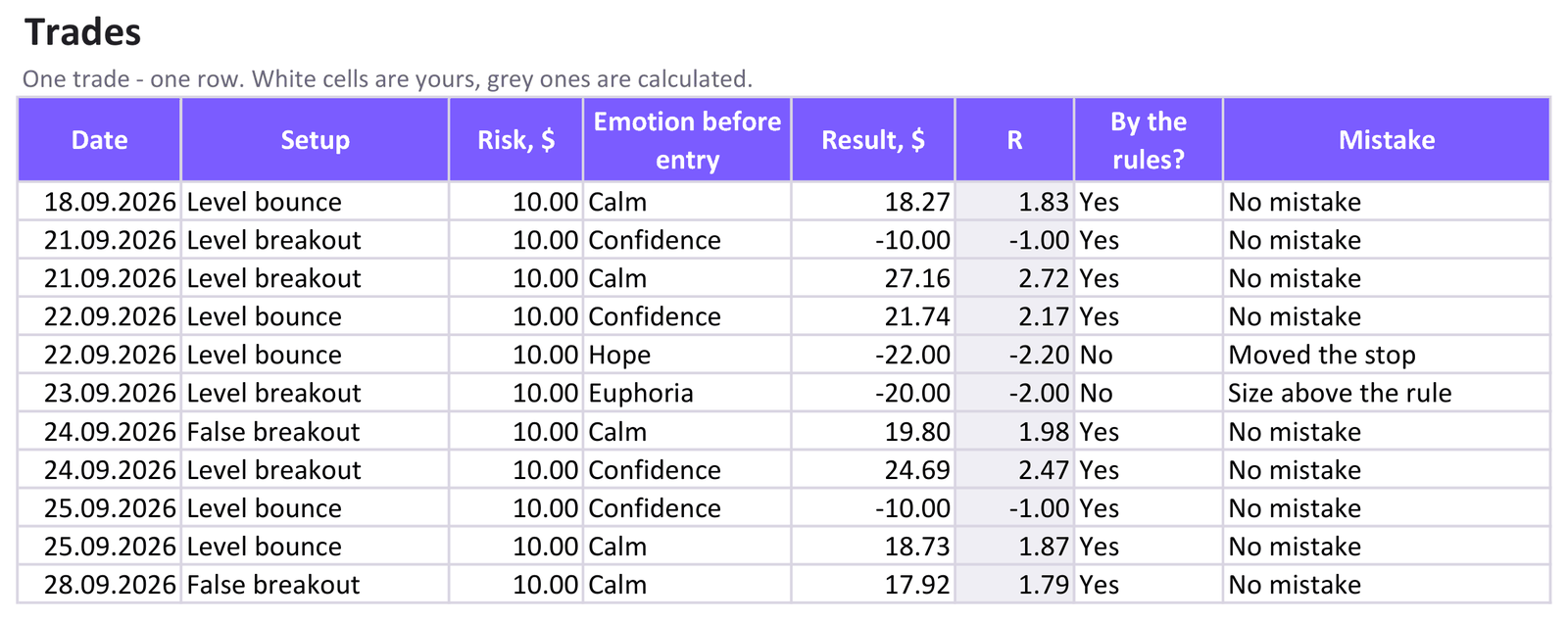
R is the result measured in risks: +2R means you made two of your risks, -1R means you lost one. Look at the two rows with a broken rule. Moving the stop turned an ordinary stop into -2.2R, and an oversized position into -2R. In dollars it looks like nothing, but in R you see it at once: one mistake ate as much as two normal trades.
The other columns - session, entry, stop, target, state, game - add them once the minimum becomes a habit. You can download the trading journal for free, no sign-up.
What do the journal stats show?
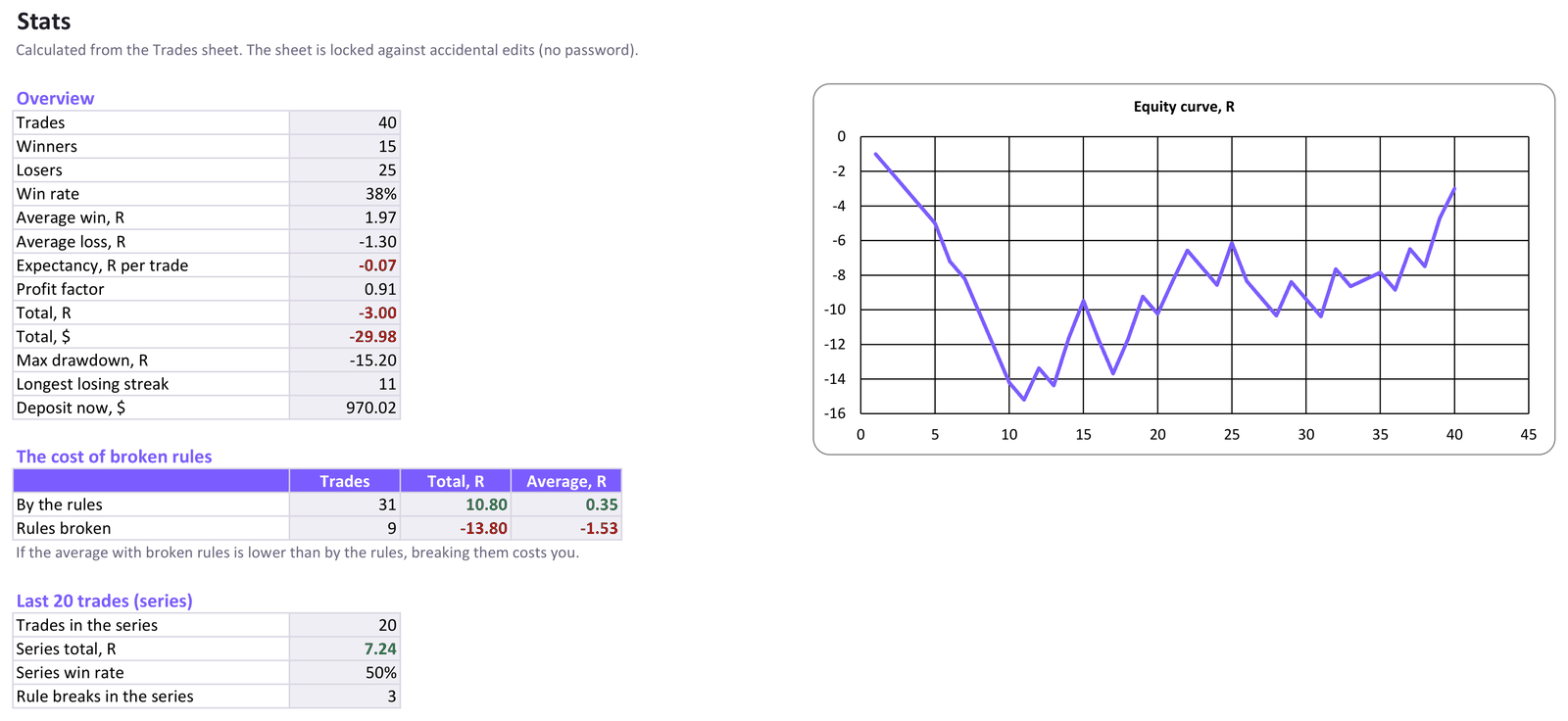
The example has forty trades. The ones made by the rules brought plus 10.8R. Nine trades with a broken rule took 13.8R, and the total went negative. The system was making money, and the trader kept handing back to the market what it earned.
Remove those nine trades and the same period would have closed in profit. You don't need to prove that number to anyone: it's calculated from your own trades, and it's hard to argue with.
In the STP Setups VIP channel, a setup arrives before the move: entry, stop and target at once. Your part is to take it by your rules and honestly log it in your journal.
Crypto video setups: entry, stop and target before the move
More about the VIP channelHow do you review your trades once a week?

The key word here is "one". Nobody can hold on to five fixes at once, but one you can. Review your best trades as carefully as your worst: that's where your setup and your best form are hiding.
What do you do if a mistake keeps repeating?

Every repeating mistake has its own logic. Traders move the stop for an understandable reason: nobody wants to lock in a loss when it seems price is about to turn. Until that logic is named, it wins. Once it's written down and taken apart, you have a ready answer, for example: "The stop is the price of the trade, not a verdict."
What is the A-B-C game in the journal?
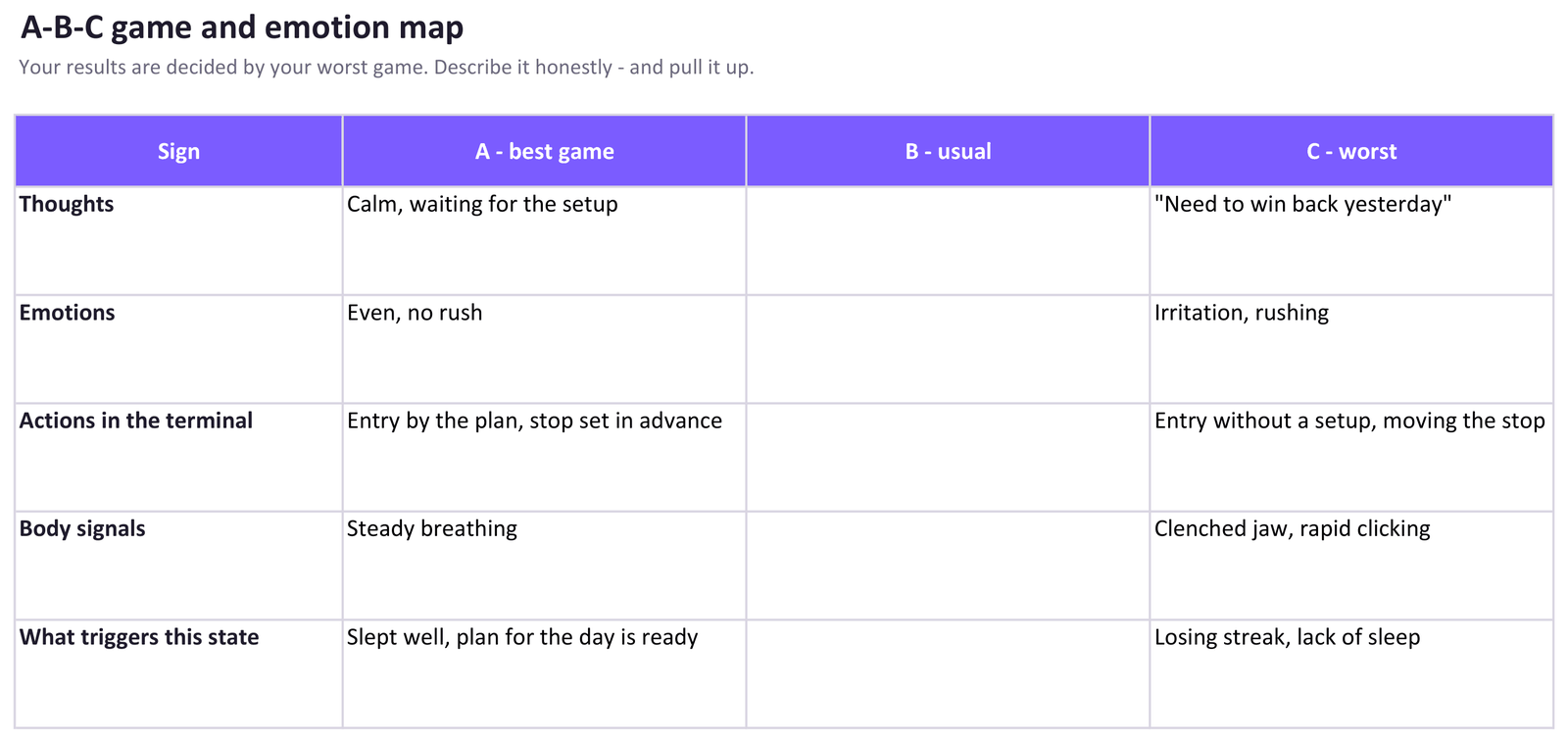
When the signs of C are described in advance, they're easy to catch. Jaw clenched, clicking more often, "need to win back yesterday" in your head - time to stop. Further down the same sheet there's an emotion map: what to do when the emotion is mild, noticeable, strong and on the edge, all the way to "close the terminal until tomorrow".
Why do traders quit their journal, and how do you keep it every day?
The habit rests on a short routine:
- In the morning - the Day sheet: sleep, energy, plan and trade limit. Two minutes.
- After every trade - a row in Trades, while you still remember what you felt.
- In the evening - rate the day by how well you followed your rules, from 1 to 10.
- Once a week - the Week sheet.
- A mistake repeated - Mistake review.
The journal stays only with you: the file sends nothing anywhere, and you can keep it on your phone, since Excel opens there too. Start with the minimum on your very next trade, and the other sheets will follow once logging becomes a habit.